

The intake device and the “Audi rings“ – are the "Audi rings" infringed here as a trade mark?
First of all, regarding the intake device. What exactly is it? The intake device is an area in the vehicle’s grille designed to intake air and direct it to specific parts of the vehicle. In the present case, the intake device includes a part that closely resembles the Audi rings.
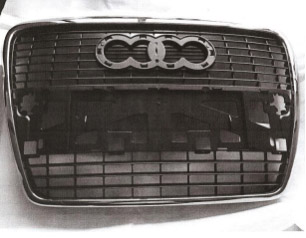
Facts of the case
The facts of the case are quickly told: An aftermarket parts dealer sold the radiator grille shown above on the internet – a spare part intended for Audi vehicles. The intake device includes a part that closely resembles the Audi rings.
Use as a Trademark?
Is this now use as a trademark of the Audi rings? The Federal Court of Justice (BGH) in Germany already dealt with this case in 2019. Audi AG sued the seller of the spare parts. A similar case is now before the European Court of Justice (ECJ), involving Audi AG and a Polish wholesaler of spare parts. In both cases, Audi AG is proceeding against the dealers based on their EU trademarks, making the European Union Trade Mark Regulation (EUTMR) applicable.
In the case of an infringement action in trademark law under Article 9(2) EUTMR, in addition to establishing the identity of the sign and the goods/services or the likelihood of confusion, there must also be a trademark use of the sign, i.e., use as a brand. Such use as a brand presupposes that the contested designation can at least also serve to distinguish the goods and services of one company from those of others in the course of sales.
The decision of the BGH and Advocate General Medina at the ECJ
The Federal Court of Justice (BGH) affirms the trademark use under Article 9(2) EUTMR and denies the exception for individual parts under Article 14(1)c) EUTMR, thus establishing an infringement. The BGH emphasizes that Article 14(1)c) EUTMR only applies when the use of a trademark is necessary and conforms to honest practices in industrial or commercial matters. This is the case when the use of the trademark is the only means to provide the public with understandable and complete information about the purpose of the goods/service. The BGH refers to the purpose of Article 14(1)(c) EUTMR: here, the aim is to counteract monopolization in the spare parts market by the trademark owner.
According to the BGH, a clarifying note in the online offer or on the delivery note could have been used to indicate that it is a spare part for Audi vehicles. Therefore, the use of the replicated Audi rings in the intake device was not necessary. The interests of the trademark owner are therefore to be given greater weight in this case. The exception under Article 14(1)(c) EUTMR is not applicable here, so there is a trademark infringement.
The Advocate General of the ECJ already denies the trademark use under Article 9(2) EUTMR and emphasizes the purpose of countering monopolization in the spare parts sector. Thus, Article 14(1)(c) EUTMR did not even need to be examined.
To the point
The goal of the EU legislator is to prevent monopolies in the spare parts sector by the trademark owner (here, the Audi manufacturer). The Advocate General justifies this by stating that the concept of the sign in Article 9(2) EUTMR should not be interpreted broadly. The Federal Court of Justice (BGH) sees this differently, affirming the infringement under Article 9(2) EUTMR. The exception under Article 14(1)(c) EUTMR is not met; the spare parts dealer could have indicated in other ways that it is a spare part for Audi vehicles. Therefore, spare parts dealers must consider whether they have other options (besides replicating the brand) to indicate the purpose of the spare part.